Saturday, 21 December 2019

What type of HDB can you really afford? - By 99.co


This article first appeared on Seedly and is part of a content syndication agreement between 99.co and Seedly.

So…

You’ve decided to apply for the latest HDB BTO Sales Launch and now have to decide what HDB flat type to choose.
Should you just buy the largest flat that you can afford?
What if you only wish to live in the flat until you meet the Minimum Occupation Period (MOP) and want to sell it?
Are there any considerations that you should think about when deciding between a 3-Room, 4-Room, or a 5-Room flat?


Before we get ahead of ourselves, let’s do a little math to find out: what type of HDB flat can you REALLY afford?

TL;DR: Only Buy As Much House As You Can Comfortably Afford

For this exercise, we determined what is the minimum average monthly household income needed when considering which type of HDB flat to get.
How did we do this? we…
  • used the Tengah November 2019 BTO Sales Launch prices as a reference (since it’s one of the most recent launches and has most of the existing HDB flat types – less studio)
  • assumed that I would be taking an HDB housing loan and would put down a 10% downpayment
  • calculated how much Enhanced CPF Housing Grant I would get with respect to my household’s monthly income bracket
  • applied the Mortgage Servicing Ratio of 30%
This is what we found out:
HDB BTO Flat TypeAverage Price
(excluding grants)
Minimum Monthly Household Income
2-Room Flexi$134,700$627
3-Room$232,000$2,100
4-Room$341,500$3,817
5-Room$459,500$5,657
3Gen$473,000$5,910
Feel free to apply my calculations to your respective BTO or Resale flat purchase to see which type of HDB flat you can comfortably afford.


How Much Does The Average HDB Flat Cost?

We’ll be taking Tengah November 2019 BTO Sales Launch as a reference since it’s one of the few HDB projects recently which has (almost) all the various HDB types to choose from, namely:
  • 2-Room Flexi
  • 3-Room
  • 4-Room
  • 5-Room
  • 3Gen
The only HDB flat type which this estate doesn’t offer is a studio flat.

Average Price Of The Various HDB Flat Types (Excluding Grants)

Using the indicative prices of the BTO project we calculated the average price of the various HDB flat types:
HDB Flat TypeAverage Price (Excluding Grants)
2-Room$134,700
3-Room$232,000
4-Room$341,500
5-Room$459,500
3Gen$473,000

Average Price Of The Various HDB Flat Types (Including Grants)

Effective 11 Sep 2019, HDB rolled out a new grant, Enhanced Central Provident Fund Housing Grant (EHG) which replaced the existing Additional and Special CPF Housing Grant.
Assuming you and your partner are first-timers who meet all the eligibility criteria for the EHG.
You can expect to receive between $5,000 to $80,000 in grants.
Naturally, the final amount you qualify will ultimately depend on your average monthly income.
Average Monthly Household Income* Over 12 MonthsEHG Grant Amount2-Room3-Room4-Room5-Room3Gen
Not more than $1,500$80,000$54,700$152,000$261,500$379,500$393,000
$1,501 to $2,000$75,000$59,700$157,000$266,500$384,500$398,000
$2,001 to $2,500$70,000$64,700$162,000$271,500$389,500$403,000
$2,501 to $3,000$65,000$69,700$167,000$276,500$394,500$408,000
$3,001 to $3,500$60,000$74,700$172,000$281,000$399,500$413,000
$3,501 to $4,000$55,000$79,700$177,000$286,500$404,500$418,000
$4,001 to $4,500$50,000$84,700$182,000$291,500$409,500$423,000
$4,501 to $5,000$45,000$89,700$187,000$296,500$414,500$428,000
$5,001 to $5,500$40,000$94,700$192,000$301,500$419,500$433,000
$5,501 to $6,000$35,000$99,700$197,000$306,500$424,500$438,000
$6,001 to $6,500$30,000$104,700$202,000$311,500$429,500$443,000
$6,501 to $7,000$25,000$109,700$207,000$316,500$434,500$448,000
$7,001 to $7,500$20,000$114,700$212,000$321,500$439,500$453,000
$7,501 to $8,000$15,000$119,700$217,000$326,500$444.500$458,000
$8,001 to $8,500$10,000$124,700$222,000$331,500$449,500$463,000
$8,501 to $9,000$5,000$129,700$227,000$336,500$454,500$468,000
*Includes ALL working persons’ (applicants and occupiers) income


What’s The Takeaway Here?

The lower your monthly household income, the more grants you’ll receive.
This means that (ideally) you should apply for an HDB BTO as early as possible.
Let’s look at two scenarios:
Couple A
  • One is a final-year university undergraduate ($0 monthly income)
  • The other is a fresh grad with a first job ($2,500 monthly income)
Their monthly household income would be $2,500 which means they qualify for $70,000 in EHG.
Couple B
  • Both have started work for at least one year ($3,000 monthly income each)
Their monthly household income would be $6,000 which means they only qualify for $35,000 in EHG.
See? The difference in grants qualified is almost twice.
But before you even apply, make sure that you’re in a committed relationship and avoid breaking-up after you BTO… it’s a really expensive and messy affair.

How Much Do I Need To Pay For My Monthly Mortgage?

Without getting into the debate of whether a bank loan or HDB housing loan is better, let’s look at how much you’d need to pay if you took an HDB housing loan.
After making the 10% down payment, you would be borrowing the rest at an interest rate of 2.6% per annum for 25 years.


Monthly Mortgage Of The Various HDB Types

Here’s what your monthly mortgage would look like:
Average Monthly Household Income Over 12 Months2-Room Flexi^3-Room4-Room5-Room3Gen
Not more than $1,500$188$585$1,032$1,514$1,569
$1,501 to $2,000$210$607$1,055$1,516$1,592
$2,001 to $2,500$233$630$1,077$1,539$1,614
$2,501 to $3,000$256$653$1,100$1,561$1,637
$3,001 to $3,500$278$676$1,123$1,584$1,660
$3,501 to $4,000$301$698$1,145$1,607$1,682
$4,001 to $4,500$324$721$1,168$1,629$1,705
$4,501 to $5,000$346$744$1,191$1,652$1,728
$5,001 to $5,500$369$766$1,213$1,675$1,750
$5,501 to $6,000$392$789$1,236$1,697$1,773
$6,001 to $6,500$414$812$1,259$1,720$1,796
$6,501 to $7,000$437$834$1,281$1,743$1,818
$7,001 to $7,500Not applicable$857$1,304$1,765$1,841
$7,501 to $8,000$880$1,327$1,788$1,864
$8,001 to $8,500$902$1,349$1,811$1,886
$8,501 to $9,000$925$1,372$1,834$1,909
^Average gross monthly household income for 2-Room Flexi (99-Year Lease) cannot exceed $7,000
If you’re wondering how I got these figures, I used a calculator like HDB’s Enquiry on Monthly Instalment to work out what is monthly mortgage (after deducting the downpayment and grant from the property price).
For young couples who:
  • want to keep their expenses low
  • want to upgrade to a larger property in the future
  • don’t plan to have children
the monthly mortgage for a 3-Room HDB BTO is relatively manageable at under $1,000.
Assuming I use the abovementioned Couple B’s income bracket ($5,501 to $6,000) as an example, they would pay around $789 a month on their mortgage for a 3-Room HDB BTO.
Which works out to be about 13% of their monthly household income.
So why is understanding this percentage important?
Here’s why…


What Type Of HDB Flat Should I Be Getting Based On My Monthly Income?


This is where we need to be really honest with ourselves and stay within our financial league.
To get a good measure of that, I’ll be using the Mortgage Servicing Ratio (MSR) which caps the amount that you can spend on mortgage repayments to 30% of your gross monthly income.
This way, we have a more realistic way of evaluating how much house you can actually afford.
In cases where the MSR is more than 30%, I’ll indicate it with a “Not Applicable” which means that if you fall within that income bracket and are considering that house, you might want to reconsider your options…
Average Monthly Household Income Over 12 Months2-Room Flexi3-Room4-Room5-Room3Gen
Not more than $1,500$627Not ApplicableNot ApplicableNot ApplicableNot Applicable
$1,501 to $2,000$700
$2,001 to $2,500$777$2,100
$2,501 to $3,000$854$2,177
$3,001 to $3,500$927$2,254
$3,501 to $4,000$1,003$2,327$3,817
$4,001 to $4,500$1,080$2,404$3,894
$4,501 to $5,000$1,154$2,480$3,970
$5,001 to $5,500$1,230$2,554$4,044
$5,501 to $6,000$1,307$2,630$4,120$5,657$5,910
$6,001 to $6,500$1,380$2,707$4,197$5,734$5,987
$6,501 to $7,000$1,457$2,780$4,270$5,810$6,060
$7,001 to $7,500Not Applicable$2,857$4,347$5,884$6,137
$7,501 to $8,000$2,934$4,424$5,960$6,214
$8,001 to $8,500$3,007$4,497$6,037$6,287
$8,501 to $9,000$3,083$4,574$6,114$6,364
From this table, we can see that most income brackets would be able to afford a 2-Room Flexi or 3-Room HDB BTO flat comfortably.
$7,000 monthly household income cap for the 2-Room Flexi (99-Year Lease) aside.
If you want a 4-Room HDB BTO, your minimum household income should ideally be $3,817 or more.
Want to spring for that 5-Room HDB BTO? Your minimum household income jumps up to $5,657 or more.
And lastly, your minimum household income to afford a 3Gen HDB BTO should ideally be $5,910 or more.Considering that we’re using an HDB Housing Loan to service the mortgage, it means that we’ll be using our monthly CPF contributions to pay the monthly mortgage.
Some of you might find yourself in a situation where your monthly CPF contribution is insufficient to cover the cost of your monthly mortgage (eg. using one person’s CPF to make payments for the HDB housing loan).
Should you perform cash top-ups on top of your CPF payments in order to ‘afford’ that house?
Yes… and no.
If your cash top-ups come from a steady stream of passive income that is unaffected by unfortunate events like you, unfortunately, losing your job, then sure… why not?
But if you’re using money from your monthly household income to supplement your CPF contributions, then you’ll want to be very careful.  BIn the unfortunate event where we  either you or your partner are unable to continuously bring in that extra amount of money to meet your monthly mortgage, you’ll find that your finances will be severely stretched.
PS: If you are lazy to do your own math, you can always use our Affordability calculator. 
This article first appeared on Seedly and is part of a content syndication agreement between 99.co and Seedly.

7 min read · 


Sunday, 15 December 2019

Here’s Why It Doesn’t Make Financial Sense To Repay Your HDB Flat Home Loan Early - Dollars And Sense

We wish we faced this dilemma during every bonus period.


Today, over 80% of Singapore’s resident population live in HDB flats. While the cost of HDB flats are typically significantly lower than an equivalent private property, it can still be expensive.
This means taking a long-term home loan, often up to the maximum 90% or 75% limits on our HDB loan or bank loan respectively, is not an uncommon practice for those who wish to afford a home in Singapore.
We have previously written about why it makes financial sense to take the maximum HDB Home Loan you can when buying your first flat. At the same time, we also think it makes financial sense not to repay our home loan for HDB flats.

You Cannot Take Out A Home Equity Loan From Your HDB Flat

Regardless of whether we take a HDB home loan or bank loan, we cannot take out a home equity loan on our HDB flat.
This means any amount we put into early repayments for our HDB flat, we cannot take out again, even if we direly need it for any reason. The only way we may be able to see our funds again is if we sell the property.
This restriction, and others, can lead to several other financial constraints for us.

# 1 You Are Left With Less Cash Buffer

One of the problems of not being able to take out a home equity loan on our HDB flat means that if we ever face any liquidity challenges over the next 25 years, we will not have this fund at our disposal to continue paying our monthly home loan or other living necessities.
This is unlike buying a private property, where you can take home equity loans, or even investing your money in the stock market or leaving it in fixed deposits. However, it may still be better than contributing to your CPF, as you can sell your home as a last resort.
The reality is that 25 years is a long time, and nobody can predict what may transpire in the future. We may lose our job in the short-term and need some funds to tide over several months of home loan payments.
To lose a financial safety net for our home may be quite a risky move, especially if we have not set other contingencies in place. This can also be exacerbated if we purchased our home thinking both us and our spouse will continue working during the entire 25 years to repay our monthly mortgage or have financially stretched ourselves to afford the home in the first place.


# 2 Lose Your Cashflow Flexibility To Adjust Your Lifestyle

As we cannot reverse the decision to repay our home loan for our HDB, we will lose a certain amount of cashflow flexibility to lead the life we want.
Professionally, we may want to take the path less travelled and start a business we’ve always thought about doing. With enough experience and the right contacts, this could be a significantly enriching and fulfilling endeavour.
Personally, we also give up the freedom of either you or your spouse taking some time off work, for any reason – to take a sabbatical, be a stay-at-home parent to care for our newborn, look after a loved one in need – or to work in a lower-paying but more meaningful role.
Without sufficient cashflow to bolster our finances, we may not be able to make these decisions.

# 3 Your Repayments Deliver (Relatively) Poor Returns

We will be paying 2.6% and approximately 2.0% on our HDB home loan and bank loan respectively.
Any amount that we repay, we will be saving this amount in interest payments. It’s not far-fetched to invest on our own to earn a better return. Simply contributing this sum into our CPF SA will yield us an annual return 4.0%. We can also choose to invest in blue chip companies or country indexes, such as Singapore’s STI ETF, to earn even higher returns, of close to 6% to 7%, by taking more risks over the long-term.
Investing the funds rather than repaying our home loan also gives us a peripheral benefit of liquidating them to pay for our home if we face any liquidity crisis.


# 4 We Risk Having To Refund Our CPF OA

This drawback should not be a common occurrence. However, we need to understand that when we sell our home, we need to refund the 1) total amount we have taken out of our CPF Ordinary Account (OA) to pay for the downpayment, monthly instalments and/or other miscellaneous charges; 2) housing grants we received from the government when we bought the home; and 3) the accrued interest on 1) and 2).
As the refund to our CPF OA takes priority, if we sell our HDB at a poor price, during a financial crisis or at the tail end of its 99-year tenure, we may have significantly less cash-in-hand than we may expect.
In this scenario, while we may be able to use the bulk of this money to buy the next home, we would have converted our cash savings into CPF savings. If we are over 55 when we sell our HDB flat, we would also face significant constraints in using the refunds into CPF as we have to lock away the Full Retirement Sum (FRS) or the Basic Retirement Sum (BRS), in our Retirement Account (RA).

There Are Reasons To Repay Your Home Loan On Your HDB

In any decision we make, there will be pros and cons. Even if the reasons above are valid, we still realise different people face different circumstances in life, and there may exist equally good reasons for them to repay their home loans on their HDB flats. In fact we even have an article about why prepaying your home loan could be awesome.
This includes having less mental stress to continuously pay a loan for a span of 25 years. With less stress, we may be able to make other good decisions for ourselves too.
Unlike investing our funds to earn a potentially better interest return, repaying our home loan on our HDB flat gives us a guaranteed return of either 2.6% or approximately 2.0% on our HDB home loan or bank loan respectively. This is typically better than many other investments with guaranteed returns.
If you adopt a strategy of gradually prepaying your home loan each year, you will also be building your CPF OA balances and saving on your accrued interest.
Ultimately, the choice of whether to prepay or not lies with you, and you should assess your individual circumstance in life to decide whether it makes sense for you.
DollarsAndSense.sg aims to provide interesting, bite-sized and relevant financial articles.


Source: Dollars And Sense


Friday, 13 December 2019

Loan-To-Value Ratio For Singapore Property: A Complete Guide - PropertyGuru


We depend on home loans to realise our property dreams, but there is a limit to how much financing we can obtain. This is because the Singapore government has put in place a tight loan-to-value (LTV) ratio that defines the maximum amount property buyers can borrow, whether the loan is from HDB or a bank.
As long as you're taking out a bank mortgage for your property purchase, you'll need to fork out a percentage of the purchase price in CASH from your own pocket as downpayment, even if you have a large pool of CPF savings. For buying a $1 million property, that would mean having to pay $100,000 cash (10% of the purchase price) as part of your minimum downpayment if you have no outstanding home loan.
And if you have an existing home loan and you're taking another one, your LTV ratio for the new loan changes drastically: your loan amount will be limited to less than half the purchase price whilst you are required to fork out up to 25% of the total purchase price in cold, hard cash. So, depending on advice given from their agents or financial advisors, buyers may opt to pay off an outstanding home loan before buying another property.
In this Guide, we'll help you understand Loan-to-Value (LTV) ratio for each scenario so you can estimate accurately the budget for your property and plan your next property purchase, whether your're a first-timer or an investor. 

What Is A Loan-To-Value Ratio?

Let's first go back to basics. The loan-to-value ratio, or LTV ratio, is the amount that you are allowed to borrow to finance your home. For instance, an LTV ratio of 90% means that you can borrow up to 90% of your property value or purchase price, whichever is lower.
In other words, if you pay more for a resale property than the amount of its HDB/bank valuation, that Cash Over Value (COV) amount must be paid in cash.
LTV ratios are implemented as a safeguard against over-leveraging by borrowers. If you’re trying to decide between an HDB loan and a bank loan, read this article to know the differences between the two.
Note that for new launches (e.g. BTOs, condominiums), the LTV ratio will always take reference from the purchase price.

LTV Ratio: HDB Loan Vs Bank Loan

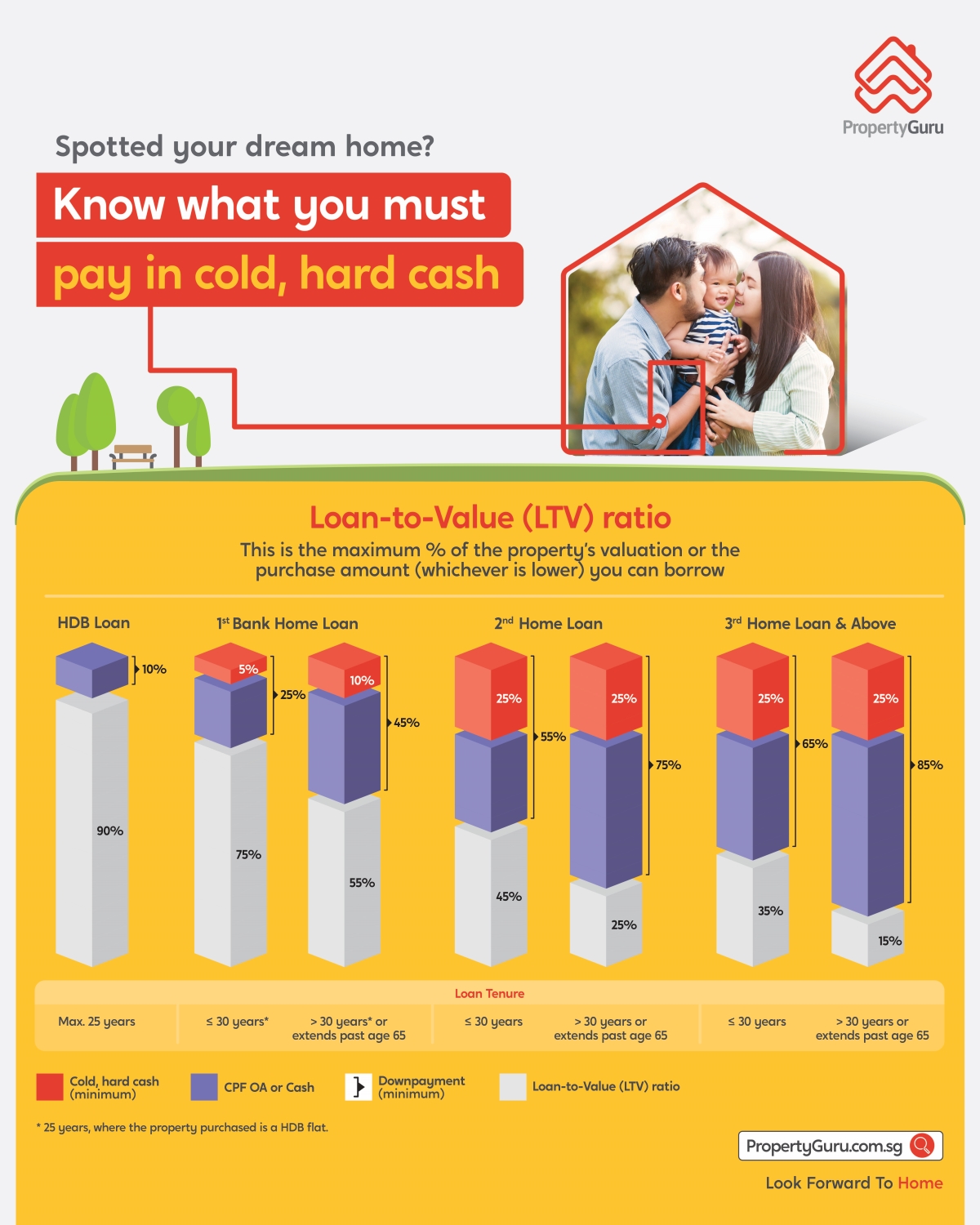
For HDB Concessionary Loans, which are only available for BTO, SBF, ROF and resale flat purchases, the maximum Loan-to-Value ratio is 90%. The remaining amount can be paid by cash, from available savings in your CPF Ordinary Account (CPF-OA), or a mix of both. There is no minimum cash component.
For a bank loan, the maximum LTV ratio is capped at of 75% LTV for the first loan (i.e. no outstanding home loans). Of the remaining 25%, 5% must be paid in cash. The remaining 20% can be paid using a combination of cash or your CPF-OA savings.
The below infographic gives an overview of the latest updated LTV ratio for buying property in Singapore. Take note that the LTV ratio is also subject to loan tenure, as well as the age of the borrower upon the completion of the tenure.
loan-to-value ltv limit singapore

Other Reasons Why You Could Be Denied The Full LTV

It’s important to note that HDB/banks do not have an obligation to loan you the full LTV. They can opt to approve a lower LTV limit, or reject your application outright in the following circumstances:

The Remaining Lease Of The Property Is Too Low

Leasehold properties with 30-40 years left on their lease may incur a LTV ratio of 60%. The reason: banks feel that properties with dwindling lease constitute a less satisfactory collateral because of lowering market value towards the end of a lease.
You may also find that you cannot use your CPF funds to pay for such properties.
(There are special cases whereby properties are purchased through monthly payments, or still obtaining a loan despite the age of the property. These are usually cases whereby the buyer has managed to negotiate a private contract with the seller via a law firm. Alternatively, it may be a special loan by a private bank to a wealthy buyer - who also has a good credit score.)

The Location Is Poor

Based on the location and state of your property, the LTV cap can be lowered significantly. Properties that are based abroad tend to get lower LTV limits. Properties located in a red-light district may also merit a lower LTV ratio.
The lender may check for lawsuits against properties too. Properties that are too run down or have major defects are also reasons to merit a lower LTV ratio.

Your Age And Loan Tenure Is Too High

As illustrated by the infographic above, if the loan tenure on your property purchase extends past 65 years of age, the LTV ratio will be capped. And as long as the loan tenure exceeds 30 years, the LTV will be similarly capped.
If you’re thinking of taking out a home loan at 35, you have to repay your full amount before you turn 65 in order to enjoy a higher LTV ratio. This is why some buyers prefer to buy their second property as soon as they save up enough for one.

Your Credit Score Is Bad

If you have a history of late payments and defaults on loans, you might be flagged as a credit risk. Banks may choose to offer you a lower LTV than the allowable limit, such as 60% instead of 75% for a 1st bank loan.
There are many things that can affect your credit score, such as:
  • Bill Payment History
    • Paying off your bills (e.g. credit card bills) on time will contribute to a better credit score
  • Level of Debt
    • You should not use expend than 30% of your credit card limit
  • Credit History Age
    • Having an older credit account shows that you have plenty of experience handling credit
  • Types of Credit
    • Having various types of credit is better, as it shows that you have experience handling them.
  • Number of Credit Inquiries
    • Inquiring about your credit too many times can damage your credit score.
If you think you have a less than perfect credit score, don’t worry, here are some ways for you to improve it.
To get more guides like this, check out PropertyGuru Guides.


Source: PropertyGuru (10 Oct 2019)


Tuesday, 15 October 2019

5 Things To Consider When Choosing Home Loans - SRX

Getting a loan is a daunting task since you’ll want the perfect one to reduce the amount of financial burden you have to carry. Yet it’s widely said that there isn’t a “best” loan out there; it will have to depend on your preferences and lifestyle. To help you make the optimal decision, here are 5 things you should consider.


1. What Loans Are You Eligible For?

To get things rolling, the first thing you’ll have to know is which loan you’re eligible for. Like most other loans, this will depend on your property type, income, age, citizenship and credit score.

For instance, the HDB Housing Loan, possibly the most popular home loan in Singapore, is available to Singapore citizens who earn a monthly salary of not more than S$6,000 (for singles) OR have a gross monthly household income of not more than S$12,000 (for families). If you don’t meet these requirements or are hoping to get a loan for a private property, then you’ll have to go for bank loans, which normally have stricter penalties, less strict eligibility and similar or lower interest rates.

Also, take note of the Total Debt Servicing Ratio (TSDR), which was introduced by the government in 2013. To put it simply, your TSDR is your monthly debt obligations compared to your monthly income and it shouldn’t exceed 60 per cent. This total debt includes all kinds of debt, from mortgage to study loans.

2. Loan Term

Imagine paying a loan for over 50 years. That surely sounds like a long road to go! However, don’t look at loans so simplistically.

Loan term refers to the duration of time that you take to completely repay the loan, which in general takes 10 to 40 years. To help you with your decision, know that the longer your loan term, the smaller the monthly payment you need to make. But the downside is that the total amount you will eventually pay is higher. Most banks also cap the maximum age at 65. This means that if you are 50, you may only have a loan term of up to 15 years.

Hence, make sure to not just consider how long, but also how much in total you’re paying. Only you, the borrower, can make a balanced call.

3. Fixed Vs Floating Rate

Interest plays a huge part in our choice of loan. That’s why it’s important to differentiate Fixed and Floating. Fixed means the interest rates stay the same over a fixed period of the loan while floating rates change. So when do you choose fixed and when do you choose floating?

Fixed lets you plan your finances better because you’ll know the exact amount you are required to pay each month. This is crucial if you are renting the house out and using the rental to cover the monthly mortgage. In general, fixed rates are more costly than floating rates. However, floating rates are more volatile and may come out to be more expensive over a longer-term, even if they are lower during the start of the loan. Floating rates are normally linked to Singapore Interbank Offered Rate (SIBOR), which can be understood as interest rates Singapore banks are willing to lend and borrow funds at, and the Swap Offer Rate (SOR), which may be slightly more volatile as it is affected more by the USD/SGD exchange rate.

4. Other Loan Conditions

Other than the interest rate, type of rate, loan terms and type of loan, you should also consider other less tangible factors such as repricing fees, valuation subsidies, and length of the lock-in period. To avoid paying repricing fees, make sure you are okay with the interest rates, especially if they are the floating kind which may increase over the years. Make sure you are happy with the lender, be it being HDB or banks. The lender may provide additional perks such as covering or subsidizing legal fees or mortgage insurance. However, banks are likely to withdraw all these perks if you refinance within the lock-in period.

5. Don’t Be Afraid To Refinance

Say you’ve been paying the loan for 4 years and the interest rates have gone up higher than is worthwhile. Or you’ve started paying for your parents and discovered that the loan they have taken up is not compatible with your lifestyle. In such cases, you might want to consider refinancing, which simply means switching over to a new home loan package (with the same bank or another one).

This requires legal and valuation fees which may be covered by the institution providing the new loan. Of course, do this after the lock-in period to minimise the penalties. Refinancing, depending on whether the bank offerings are financially sensible for you, can mean huge savings in the long run.

Source: SRX (10 Oct 2019)