Tuesday, 8 June 2021

What happens if your housing loan deductions reach your CPF Basic Retirement Sum (BRS)? - 99.co


When buying a house, some of us would use our CPF savings to pay for our housing loans. But the thing about CPF is that it’s for retirement, so there’s a limit to how much you can use it for housing. Since the limit depends on the Basic Retirement Sum, what happens if your housing loan deductions reach it? 

Before we explain further, let’s first talk about what and how much you can use your CPF Ordinary Account (OA) savings for housing. 

(You might also want to sign up for our webinars at the upcoming Singapore Property Show 2021 happening on 22, 23, 29 and 30 May here for more info on financing your property.) 

For housing, what can your CPF OA savings be used for? 

Most people use their CPF OA savings for their property downpayment. Some use it to pay off their housing loan as well, whether it’s HDB loan or bank loan. 

But the usage of CPF OA savings is not limited to those. It can also be used to pay your stamp duties and legal fees. And if you’re paying the home loan for your HDB flat with CPF, you’ll need to be insured under the Home Protection Scheme (HPS), which will be paid using CPF. 

For private properties, you can also use the CPF OA savings to pay for the loan for house construction or the purchase of vacant land. 

At the same time, there’s a limit to how much you can use your CPF for housing. Generally, it depends on the type of your home loan and property. 

Advertisement


What’s the limit for using CPF OA savings for housing? 

Ultimately, CPF savings is for retirement so there are some limits to adhere to. This ensures you don’t spend too much of it on your housing loan at the expense of your retirement funds. 

One of the major rules is that you can’t use your CPF if the property has less than 20 years of lease remaining. 

For most people, the property bought has a remaining lease covering the youngest owner until age 95. As of 10 May 2019, the limit on the use of CPF savings depends on the type of property and housing. 

If you’re buying a new HDB flat with an HDB loan

Other than the Loan-to-Value (LTV) limit, there’s no limit to how much you can use your CPF savings if you’re buying a BTO with an HDB loan. So you can use all your OA savings to pay off the loan. 

If you’re buying a resale flat with an HDB loan

The limit is the lower of the valuation or the property price at the time of purchase. This is also known as the valuation limit. If you want to use more than this limit, you’ll need to set aside the Basic Retirement Sum (BRS) in your CPF accounts first. 

Let’s say the purchase price of the property is S$320,000 and its valuation is S$300,000. If you want to use more than the S$300,000 limit to pay off your remaining loan, you’ll need to set aside the BRS first. 

Advertisement


If you’re buying a new HDB flat, resale flat or private property with a bank loan

Similar to resale flats bought with HDB loan, the limit is the lower of the valuation or property price at the time of purchase if you don’t set aside the BRS in your CPF. 

But if you set aside the BRS in your CPF, you can use up to 20% of either the valuation or property price (whichever is lower) from your OA savings to pay off your loan. This essentially means that you can use up to the withdrawal limit, which is 120% of the valuation limit. 

Using the same figures to illustrate, you’ll be able to use up to S$300,000 + additional S$60,000 = S$360,000 if you set aside BRS in your CPF account. 

For properties with a remaining lease that doesn’t cover the youngest owner till age 95, the limit to how much you can use your OA savings will be prorated based on the youngest owner’s age. 
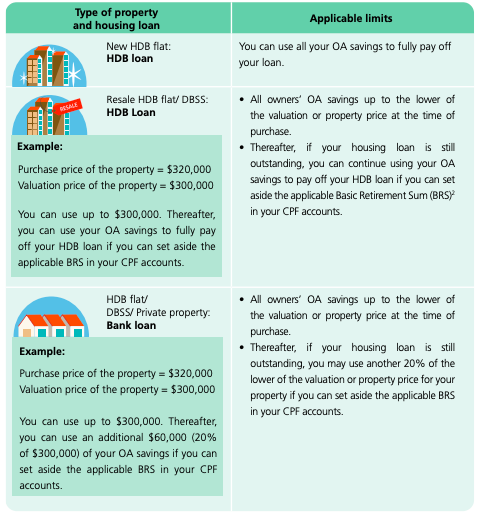
Infographic on withdrawal limit and basic retirement sum when using CPF for housing
Infographic on the limit when using CPF to pay your housing loan. Source: CPF

If you’re buying another property

Already bought at least one property with your CPF savings? If you’re buying a new property that can cover you till you’re 95, you’ll need to set aside the BRS in your CPF account. 

Otherwise, you’ll have to set aside the Full Retirement Sum (FRS) before buying another property. 

Now that you know about the limit, you might be wondering what these retirement sums are all about. 

Advertisement


What are all these Retirement Sums? 

They basically refer to the amount of CPF savings that will be set aside for retirement. When you turn 55, a Retirement Account (RA) will be formed. Savings from your Special Account and OA will be transferred to this RA to meet the Retirement Sum. 

The retirement sum depends on your age. It will be higher for those who turn 55 in the later years because of inflation and the higher cost of living in future. 

Here are the retirement sums for those turning 55, up to the year 2022. If you’re below 55, you can refer to the current BRS. 

55th birthday in the year of Basic Retirement Sum​Full Retirement Sum​Enhanced Retirement Sum​
2017S$83,000​S$166,000​​S$249,000
2018S$85,500S$171,000​S$256,500​
2019S$88,000S$176,000​S$264,000​
2020S$90,500S$181,000​S$271,500​
2021S$93,000S$186,000​S$279,000​
2022S$96,000S$192,000S$288,000

After the savings are transferred to meet the Retirement Sum, you can use the remaining balance to pay for your housing loan. 

So even as you continue to work after 55, you can still use the monthly contributions that go into your OA to service your mortgage. This applies even if you don’t meet the Retirement Sum. 

Elderly couple
Using your CPF to pay your housing loan lowers the amount set aside for retirement.

But what if your housing loan deductions reach the Basic Retirement Sum?

If you plan to use more than the valuation limit to pay your housing loan with CPF, you can top up your CPF to continue paying your mortgage with it. However, do note the 120% withdrawal limit if you’re taking a bank loan. 

Planning to continue using your OA to pay for your housing loan after you turn 55? You can apply to reserve your OA savings before they’re transferred to your RA. 

You can either reserve all or part of your OA savings via my cpf Online Services at least three weeks before your 55th birthday. 

But even if you’ve submitted the request to reserve your OA savings, the CPF Board can still transfer it if any of the following happens: 

  • No payment is made for your property for six months
  • You have not used CPF savings towards the property for five years
  • Your property is sold 
  • When the purchase of the property is aborted

In addition, doing so lowers the amount set aside for retirement. It also affects the amount that you can withdraw and receive in monthly payouts. Alternatively, you might want to fork out cash to pay your remaining mortgage. 

You might also want to note that if you ever sell your property, you’ll need to put back the CPF savings used plus the 2.5% accrued interest into your CPF account. So before you jump into paying off your mortgage with your CPF savings, be sure to plan your financials first. 

7 min read · 


Source: 99.co (09 Jun 2021)


Advertisement


Thursday, 3 December 2020

MAS report: Singaporeans could face trouble servicing home loans in 2021 - 99.co


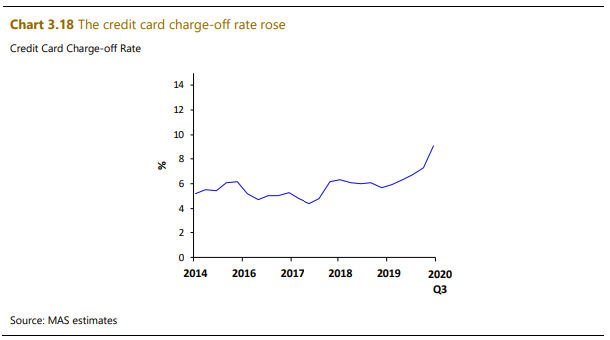
On 1 December, the Monetary Authority of Singapore (MAS) noted in its annual financial stability review that, as a result of an gradual uptrend in unsecured credit charge-off rate in Q3 2019, more households could “face difficulties in their housing payments” in the coming months.

Examples of unsecured credit are credit cards and personal lines of credit. The unsecured credit charge-off rate, which measures bad debt written off during the year against the average rollover balance, increased from 5.9% to 9.1% between the third quarter of last year and the same period this year.

mas report credit card charge off rate chart

According to MAS, the unsecured credit charge-off rate is a leading indicator for the credit quality of housing loans. This is because, in an initial period of financial distress, a borrower is likely to first miss payments for their unsecured credit bills. This may lead to defaults on monthly home loan repayments in the near future.

MAS also noted in its report a silver lining, property asset values have remained robust in 2020, which is helping sustain asset values and household net wealth.

Advertisement


Households more financially vulnerable than last year

As Covid-19 led to a shape fall in employment and wage incomes of Singaporeans in the first-half of this year, the overall Household Sector Financial Vulnerability Index, or FVI, increased in Q3 2020, MAS reported.

Since the circuit breaker in Q2 2020, household debt-to-GDP, which had been declining pre-Covid, increased 1.9 percentage points from 63.1% in Q1 2020 to 65.0% in Q2 2020, and a further 2.1 percentage points to 67.1% in Q3 2020.

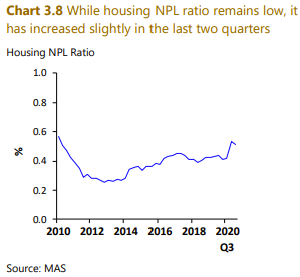
The housing Non Performing Loans (NPL) ratio also “increased slightly in the last two quarters” by about 0.1%, although the ratio remains well below 1% at about 0.5% currently (which means one out of about 200 borrowers have issues with on-time housing loan repayment). Housing loans account for about three-quarters of total household debt, and are a key determinant of overall household financial vulnerability, according to MAS.

mas report financial stability household default home loan chart

At the same time, household debt as a percentage of income, which has remained stable since 2015, is expected to “increase slightly in the near term as accumulated labour market slack weighs on wages,” MAS said.

Despite reduced income and GDP, simulations by MAS suggest that Singapore households’ debt servicing burden “remains manageable” under the stress of both current and potentially extended Covid-19 economic impacts. Assuming further income shocks of up to 25%, median household mortgage servicing ratios (MSR) will still remain lower than 60%.

Advertisement

According to the report, property cooling measures in preceding years, such as the tightening of the loan-to-value (LTV) ratio, were helpful in improving households’ balance sheets. Household liquid assets, such as cash and deposits, continued to exceed total liabilities in Q3 2020, providing households a financial buffer against income shocks.

Furthermore, relief measures have also been instrumental in helping households with cashflow concerns. About 36,000 applications to defer property loan repayments have been made as of August this year.

[Recommended article: Here’s all the things property buyers/owners can defer paying until 2021]

Property market buoyant, sustaining asset values and households’ net wealth

According to the MAS report, household net wealth (defined as household assets less household debt) increased from 3.8 to 4.4 times of GDP from Q3 2019 to Q3 2020.

mas report financial stability household wealth chart

MAS noted that while the increase is partly due to the fall in GDP caused by Covid-19, the increase in household net wealth is also a result of asset values (such as equity and property prices) remaining robust despite the economic slowdown.

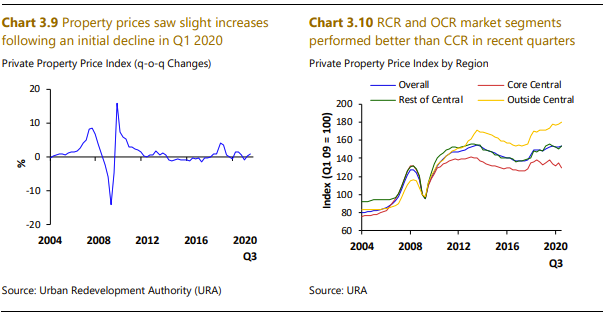
The private residential market has remained resilient in 2020, MAS said. Prices returned to pre-Covid-19 levels in Q3 2020 following an initial decline in Q1 2020. The recovery of transaction activity in Q3 2020 is also supported by an “accomodative interest-rate environment“.

Compared to the Global Financial Crisis in 2008 and 2009, MAS noted that prices of private homes had “less pronounced volatility” that “points to some degree of underlying support and resilience in the market.

Advertisement

Unlike in the previous periods where price trends across different regions were aligned, the the Rest of Central Region (RCR) and Outside of Central Region (OCR) saw price gains of 0.3% and 1.4% in 2020 to date respectively, compared to price declines of 3.4% in the Core Central Region (CCR).

mas financial stability report property prices

Transaction activity for private homes was driven by resident purchases, with foreign demand remaining low because of continuing travel restrictions, MAS noted. As of Q3 2020, residents (citizens and permanent residents) accounted for around 95% of all transactions, and Singapore citizens’ share of transactions inched up to a “historic high” of 81.9%, according to MAS.

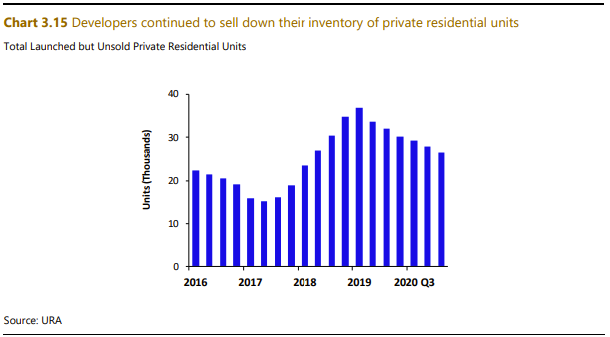
As a result of a buoyant property market, the number of unsold units in the supply pipeline declined for the sixth consecutive quarter as the recovery in developers’ sales outpaced additions to unsold supply inventory, MAS noted. The supply of unsold units are now down to Q2 2018 levels.

MAS also noted improving developer sentiment. “Given the progressive decline in unsold inventory, some developers have been keen to replenish their landbank as reflected by the healthy participation for the Government Land Sales (GLS) tenders which closed in October 2020,” it said.

Sentiment among developers was also helped by the government’s temporary relief measures that extended their deadlines for Additional Buyer’s Stamp Duty (ABSD) remission and Project Completion Period. These measures provided developers some flexibility to manage their sales timelines.

“Developers are under less immediate pressure to move units to meet ABSD remission deadlines,” said MAS.

mas financial stability developer chart

Rental vacancies fall, CCR worst hit

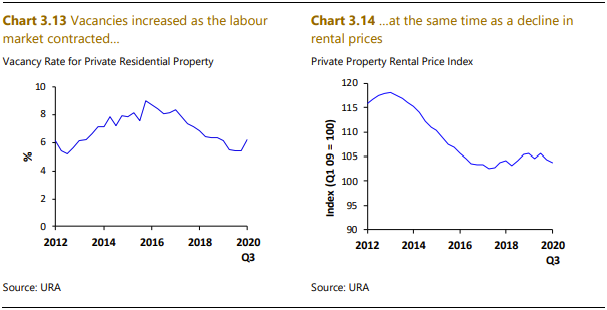
Hiring slowdowns and departure of expatriates due to Covid-19 have caused vacancy rates of private residential properties to increase from 5.4% and 6.2% between Q2 and Q3 2020, reversing a downtrend since 2016.

Rentals declined for a second successive quarter by 0.5% in Q3 2020 but, similar to price trends, it was only the CCR that took the hit. Amongst non-landed properties, CCR rentals fell by 2.1% but RCR and OCR rentals increased by 0.3% and 1.0% respectively.

Advertisement

For landlords affected by the fall in rental demand, MAS warns that “borrowers relying on rental income to meet their mortgage instalments on investment properties could face difficulties in repayment.”

“Prospective buyers should accordingly factor in the possiblity of further weakness in rental income when committing to purchases of investment properties,” it added.

mas financial stability rental chart

Exercise prudence when buying property, MAS advises

“Close monitoring of housing loans from more vulnerable households is necessary in the upcoming months given that the labour market recovery will be protracted,” the MAS said.

Aware that some households that currently have a strong cash and liqudity balance and may be considering upgrading or making new property purchases, MAS urged them to be cautious, and to consider refinancing existing loans.

“Households should be prudent in taking up new debt and in committing to property purchases as the labour market recovery is expected to be protracted. Whenever possible, they should continue servicing or consolidating their existing obligations to enhance resilience against unexpected shocks.”

6 min read · 

Source: 99.co 

Advertisement


Wednesday, 26 August 2020

HDB Concessionary Loan: Know your eligibility + How to apply for HLE - by 99.co

 If you’re looking to buy a HDB flat, and your monthly salary does not exactly make you a millionaire, you will sooner or later have to get a home loan. Other than taking a loan from a bank, as a flat buyer you can apply for the HDB Concessionary Loan (or a HDB loan, in short), a special type of mortgage issued by the government body.

(Not sure whether a bank loan or an HDB loan fits you best? Read our previous post.) This article will tell you what you need to know about taking a HDB Concessionary Loan.

Advertisement


Your eligibility for a HDB concessionary loan

The key thing to note is that the HDB loan has an income ceiling of $14,000 ($21,000 for extended families). If the annual assessable income for both applicants (e.g. you and your partner) exceeds this amount, you’ll have to take a bank loan instead. After all, the intention of HDB in financing mortgages is to make home loans with stable terms available for those who might not be able to get a bank loan on favourable terms, if at all (i.e. flat buyers of lower income).

That said, while the HDB loan is seen as a godsend for some, HDB as a lender is also obliged to exercise fiscal prudence. In short, this means a lower income will get you a lower maximum loan amount, affecting which HDB flat you can afford.

To guage how much in HDB loans you can obtain, take a minute to obtain your HDB loan estimate. The debts that HDB buyers can take on, inclusive of mortage and any outstanding loans, is capped at 30% of monthly income. For example, if you and your spouse earn a combined $10,000 but use $1,000 a month to pay off a car loan, you’ll can take on a maximium mortage where the monthly installment does not exceed of $2,000 a month ($10,000 x 30%, then subtracting $1,000).

Advertisement

(adsbygoogle = window.adsbygoogle || []).push({});


Furthermore, a odd-job or part-time income stream will also have to undergo what’s called a ‘haircut’, where only 70% of that income is considered for the loan application. Taking again the above example, this would mean that the couple can only take on a maximum monthly installment of $1,100 per month (i.e. $7,000 x 30% – $1,000).

These are also the following eligibility criteria you’ll have to meet to be eligible for a HDB concessionary loan:

  • You are a Singapore Citizen
  • Your gross monthly household income is less than $14,000 ($21,000 for extended families)
  • You do not own, or have not owned any residential private property in the 30 months before the application for the HDB loan
  • You do not own more than one market/hawker stall or commercial/industrial property*

*If you do operate a market/hawker stall or commercial/industrial property you have to work in it yourself.

A more detailed version of the list above can be found here.

If you want to be sure, you can also fill out this 30 second questionnaire to see whether you are eligible for a HDB Concessionary Loan.

If you’re taking a loan to buy a HDB flat, the maximum portion of your income you can use to pay your mortgage is 30%.


Next step: Apply for the HDB Loan Eligibility Letter (HLE)

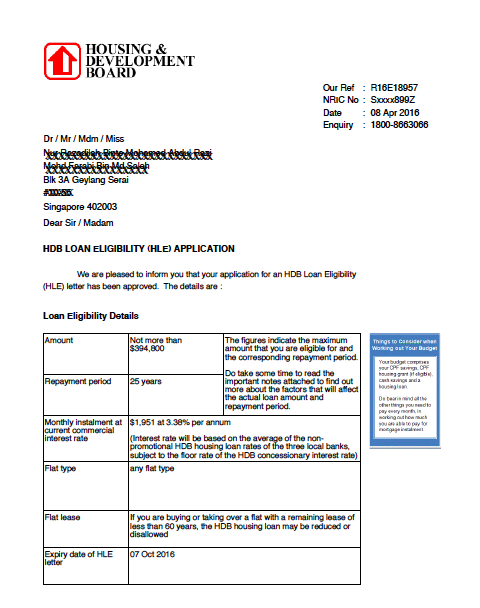
The next question troubling you is probably: so… how much loan can I get? You can find out by applying for an HDB Home Loan Eligibility (HLE) letter, which specifies the maximum loan amount from HDB you can stand to receive. The HLE letter should be obtained before your first appointment (for BTO buyers) or before you sign the Option to Purchase and pay the option fee as deposit (for resale flat buyers).

Advertisement


The maximum amount that HDB will be granting you depends on three main factors:

  • Your age
  • Your income
  • Your financial standing

It’s logical to see how your age and income both influence your maximum loan amount. Given the unit to buy and the borrower’s financial standing (i.e. outstanding debt) is the same, HDB would extend a higher loan amount to the younger applicant simply because he has more years to pay off the loan before his/her retirement age, which is the cut-off age for any HDB loan.

As for your financial standing, this is a little bit more complicated. To begin, here are the things that do NOT influence your financial standing, and DO NOT AFFECT the amount of money HDB would be willing to lend you:

  • Rental income
  • Interest from fixed deposit/ savings account
  • Alimony allowance (divorce cases)
  • Bonuses
  • Dividend income
  • Director fees
  • Overtime income
  • National Service allowance
  • Claims/ reimbursement/ expenses
  • Overseas allowance for scholarships

Here’s how HDB takes income into consideration before specifying a maximum loan amount on your HLE letter. For a regular employee, the two most important documents that you are required to show HDB is a payslip — latest 3 months — from your employer and last 15 months’ worth of CPF contributions.

For self-employed, part-time and odd job workers, documents such as your annual tax assessment form (IR8A) needs to be furnished to HDB. They might also have to make a Statutory Declaration to state what they’ve declared is honest and true.

Advertisement


A joint applicant who are unemployed will also have to make a Statutory Declaration that he/she is unemployed.

Required documents for HLE letter:

HDB requires different documents for different people. In a nutshell, the less stable your income the more proof HDB wants before they would grant you a loan.

For an employee with CPF contributions

  • Latest three months’ payslips
  • 15 month CPF history

For an employee without CPF contributions

  • Latest 12 months’ payslips
  • latest 12 months’ bank statements
  • Credit Bureau report

For Self-Employed person

  • A valid Accounting and Corporate Regulatory Authority (ACRA) Business Profile computer or a valid licence of business/trade
  • Latest notice of assessment from the IRAS or a Certified Annual Statement of Accounts from an audit firm

For Commission-based and part-time workers

  • The Commission statements and payslips for the last 12 months>
  • Latest 15 months’ CPF history
  • Credit Bureau report
  • Latest 12 months’ bank statements

For odd job workers

  • Latest Notice of Assessment from the IRAS or a recent letter from the employer certifying your job designation, commencement date, and your commission/salaries for the last 12 months
  • Latest 15 months’ CPF history
  • Credit Bureau report
  • Latest 12 months’ bank statements

For a pensioner

  • Latest 3 months’ payslips, or a recent letter from the previous employer stating the monthly pension received for the last 3 months
  • Credit Bureau report
  • Latest 12 months’ bank statements

For an unemployed person

  • If you have been unemployed for less than 3 months then you should show income proof for the preceding months from the previous employer the gross monthly income and the last day of service plus you have to show the last 15 months worth of CPF history
  • If you have been unemployed for longer than 3 months you have to submit a Statutory Declaration, which you can request at the HDB Hub loan counter or any HDB branch

An HLE letter takes about 3 weeks to obtain. In the event that you do not get the amount you were hoping for, you can basically reverse engineer the process.

To do so, start by looking at what factored into HDB’s decision and improve on these factors. If you are a commission-based worker, for instance, there is ample scope for increasing your loan quantum (i.e. if your commission income decreased sometime in the last 12 months you can try to take on more work, get a higher average monthly pay for 12 consecutive months and apply again. Or you might have outstanding debt that would raise your maximum loan amount if you repay them fully before reapplying.

Again, to give you a useful idea of the maximum loan amount you’d get before you start your home search, HDB has a useful calculator to estimate how much loan your HLE letter will grant you.

>Note: If you are buying a Build-To-Order (BTO) flat from HDB, then your financial position will be reviewed twice; once before you decide to purchase the flat, and another time nearer to the completion date of the flat. Make sure your financial ability to service the housing loan has not changed by this point. While quite rare, it is possible that after you have gone through the BTO process, and put down your down payment, you are unable to get an HDB loan. To avoid this disappointment so close to the finish line, we advise you to remain fiscally prudent and prioritise financial stability.

HDB HLE home loan eligibility letter.
A sample of the HDB Home Loan Eligibility letter, or HLE letter in short.

The Credit Bureau Report

As noted above, getting a HDB Concessionary Loan also requires a credit report from certain buyers. While most people are not aware of this, the Singapore Credit Bureau (SCB) pools all your credit information from different banks and companies, giving you a personalised score! You can request your credit score here on www.creditbureau.com.sg. If you do not have an AA score (the highest), you have room to improve it and by that positively influence the maximum loan amount you may get.

Advertisement


The process of applying for an HDB Concessionary Loan

There are TWO main steps to this process.

Firstly, you need to obtain an HDB Home Loan Eligibility letter (HLE letter). Apply for it on the HDB website.

Secondly, when you have the HLE letter, upload all the necessary documents unto the HDB portal.

That’s it. You can then track your application on the MyHDB portal. Typically, HDB replies within 14 days.

If your application is accepted, HDB will be in touch to finalise loan matters, such as whether you intend to service the mortgage payments in cash, or via you and/or your co-applicant’s CPF Ordinary Account(s) (CPF-OA). Note that the interest rate for a HDB Concessionary Loan is pegged at 0.1% above the CPF-OA account interest rate.

Thinking of a taking bank loan instead? Weigh the pros and cons.

9 min read · 

Source: 99.co (27 Aug 2020)

Advertisement